
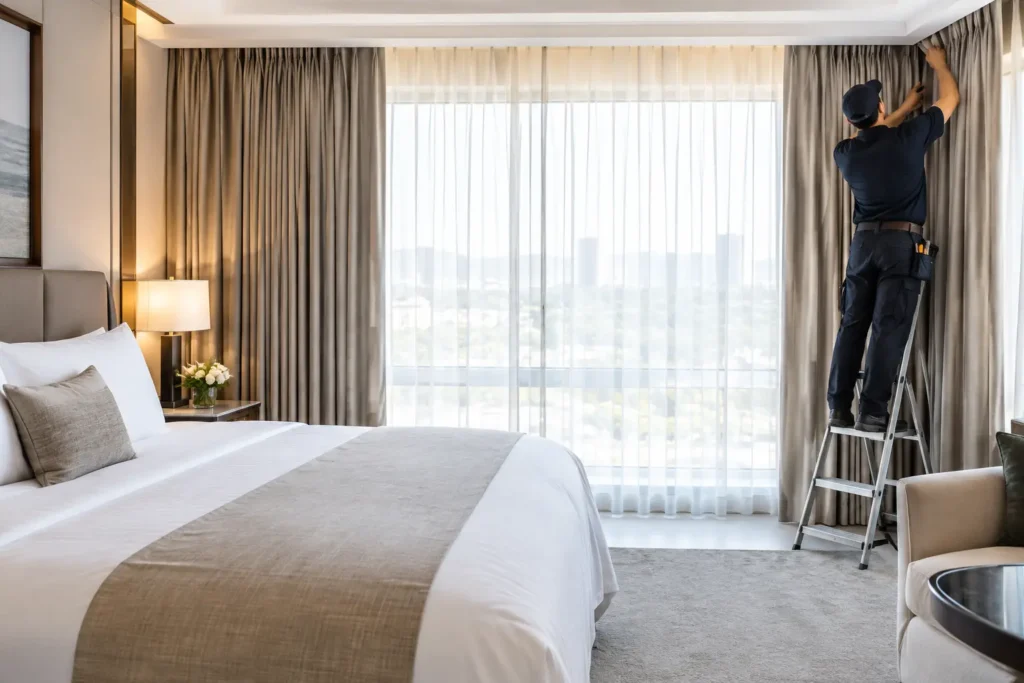
A well-planned hotel drapery installation example reveals why window treatments are never a finishing detail in hospitality design. In a guest room, the drapery has to look exceptional at first glance, close fully after a long flight, reduce unwanted light in the morning, withstand constant use, and coordinate with every finish from the headboard to the carpet. That combination calls for more than attractive fabric. It calls for accurate measurement, carefully selected hardware, and professional installation.
For hotels, serviced apartments, and boutique hospitality spaces, the right curtain system sets the tone for comfort. It also protects guest privacy, supports better sleep, and gives the room a more considered, premium appearance.
A Hotel Drapery Installation Example: The Guest Room Setup
Consider a contemporary luxury guest room with a floor-to-ceiling window measuring 12 feet wide and 9 feet high. The view is a valuable feature during the day, but the room faces neighboring buildings and receives strong early sunlight. The design objective is to preserve the view, provide complete nighttime privacy, and create a layered finish that feels warm rather than heavy.
The selected treatment uses two fabric layers installed on a concealed dual-track system. A soft, light-filtering sheer faces the room and creates a refined daytime look. Behind it, a premium blackout curtain provides privacy and darkness when needed. Both layers run wall to wall and are mounted close to the ceiling rather than directly above the window frame.
This extra width and height matter. Extending the track beyond the window allows the curtains to stack mostly off the glass when open, making the window appear larger and allowing more natural light into the room. Ceiling-level installation also creates a taller, more luxurious visual line, which is especially effective in compact hotel rooms.
The blackout fabric is finished with a quality lining and weighted hem so it hangs in clean, even folds. The sheer is chosen for its softness, texture, and ability to diffuse daylight without making the guest room feel closed in. For a warm neutral interior, ivory sheers with taupe or charcoal blackout drapes can add depth without competing with the room’s artwork, upholstery, or bedding.
Why Layered Hotel Curtains Perform Better
A single blackout curtain may be practical, but it rarely delivers the same daytime experience as a layered system. Guests often want daylight without direct visibility from nearby buildings. Sheers solve that problem while adding an elegant, finished appearance to the room.
At night, blackout curtains take over. A properly specified blackout drapery should overlap at the center, return toward the wall at both ends, and sit close enough to the ceiling and floor to minimize light gaps. No curtain can make a room completely dark if light enters around the track, under the door, or through other architectural openings. However, expert fabrication and fitting can reduce the most noticeable light leakage around the window.
The choice depends on the hotel’s category and room use. A business hotel may prioritize durability, fast operation, and a clean modern profile. A resort may place more emphasis on decorative fullness, tactile fabrics, and a softer atmosphere. Suites, executive rooms, and high-end serviced apartments can benefit from fuller drapery headings and motorized operation, while high-turnover rooms may need a more streamlined system that housekeeping can manage easily.
Measurement Is Where the Finish Begins
In hospitality projects, measuring only the window width is a common and costly mistake. The installation team must assess the entire wall, the ceiling condition, air-conditioning grilles, sprinkler locations, electrical points, furniture placement, and the distance between the curtain and any window handles.
For this example, the dual track is specified at 15 feet wide, even though the glass is only 12 feet wide. This gives enough stacking space for the curtains and creates the wall-to-wall hotel look guests associate with quality interiors. The finished curtain drop is measured carefully to stop just above the finished floor. A hem that drags collects dust and can be damaged by luggage or vacuuming, while a curtain that sits too high looks under-measured.
Fabric fullness is also calculated rather than guessed. Sheers generally need generous fullness to retain their soft, flowing appearance when closed. Blackout curtains can use a more controlled fullness depending on the heading style, fabric weight, and desired look. The goal is consistent folds, not unnecessary bulk.
Choosing the Right Track and Heading
The hardware behind the drapery determines how the room performs every day. Hotel curtains are opened and closed far more often than curtains in most private homes, so a lightweight domestic rod is rarely the right answer. Durable aluminum tracks, quality carriers, stable brackets, and properly secured fixings help the system remain smooth and quiet over time.
In this hotel drapery installation example, a ceiling-mounted dual aluminum track is recessed into a simple curtain pocket. The pocket hides the hardware and lets the fabric appear to emerge from the ceiling. It is a small architectural decision with a major visual effect.
Wave-style heading is often a strong choice for modern hotels because it creates uniform, continuous folds and operates smoothly across a track. Pleated styles can be equally elegant, particularly in classic interiors or formal suites, but they may require more detailed dressing after cleaning and maintenance. The best heading is the one that complements the room concept while meeting the operational needs of the property.
When Motorized Drapery Is Worth It
Motorized curtains elevate the guest experience, especially in premium rooms, suites, meeting spaces, and rooms with wide or hard-to-reach windows. A guest can open the sheers in the morning or close the blackout drapery at night using a wall switch, remote, or integrated room-control system.
Automation is not only about luxury. It can reduce wear caused by pulling fabric by hand, support consistent operation, and make large curtain panels easier for staff to manage. For hotels, it also creates an appealing arrival moment: lights can turn on, sheers can open, and the room can feel ready for the guest.
Still, motorization should be selected with a practical plan. The installer needs to confirm power access, motor placement, track capacity, controls, and access for future servicing before the curtains are fabricated. For smaller rooms with limited budgets, manual tracks with quality wand or draw-cord operation may be the more sensible investment.
Details That Protect Hotel Standards
Beautiful fabric cannot compensate for poor planning. Hotel buyers should ask about the practical specifications that affect safety, maintenance, and long-term appearance. Depending on the project and local requirements, drapery may need fire-retardant certification. Fabrics should also be selected for colorfastness, durability, and the cleaning method the property can realistically maintain.
The installation should account for the room’s daily operations. Curtains must clear bedside tables and chairs, operate without catching on window handles, and remain easy for housekeeping to reset. If the drapes are part of an acoustic strategy, the design should consider fabric weight, fullness, wall coverage, and the room’s other surfaces. Drapery can soften echo and improve the sense of calm, but it is not a substitute for a complete soundproofing system.
Final dressing is another detail guests notice without realizing it. Each panel should be trained into consistent folds, the hems should align, the center overlap should close correctly, and the sheer and blackout layers should move independently. This is the difference between curtains that simply cover a window and drapery that completes a hospitality interior.
Professional Installation Makes the Design Work
A hotel curtain project often involves coordination between interior designers, fit-out teams, electricians, housekeeping requirements, and hotel operations. The most reliable approach is an end-to-end service that includes consultation, site measurement, fabric selection, custom tailoring, track specification, installation, and final testing.
Elegant Blinds & Curtains provides made-to-measure hotel curtains and professional fixing for hospitality spaces in Dubai, helping project teams create rooms that feel polished, private, and comfortable from the first guest stay. Whether the requirement is classic blackout drapery, elegant sheers, sound-softening fabrics, or motorized curtain systems, each installation should be tailored to the room rather than forced into a standard size.
Before approving any hotel drapery, ask to see the full window treatment operating in place – open, closed, layered, and viewed from the bed. That single check often confirms whether the design delivers the privacy, comfort, and quiet luxury guests remember.