
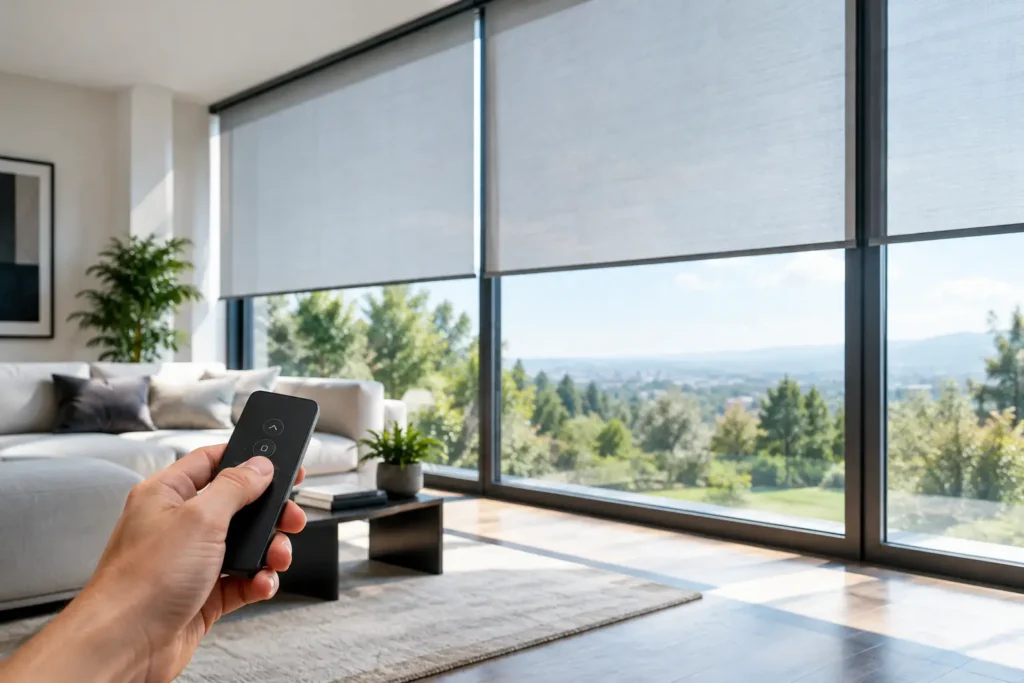
A room can look perfectly furnished and still feel inconvenient when every sunrise, glare, and privacy adjustment requires a trip to the window. Window automation changes that daily experience. With motorized curtains or blinds, light control becomes part of how your home or workplace works: quiet, precise, and ready when you need it.
For a bedroom, that may mean blackout curtains closing at bedtime without leaving the comfort of your bed. In a sun-filled living room, it can mean lowering roller blinds before afternoon heat takes over. In an office, automated window coverings can give a meeting room privacy in seconds while maintaining a polished, professional appearance.
The appeal is not simply technology. It is the combination of comfort, design, and thoughtful installation. When automation is planned around the room, it makes custom window treatments feel even more refined.
What Window Automation Changes in Everyday Spaces
Motorized blinds and curtains replace manual cords, chains, and hand-drawn tracks with a discreet motor controlled by a remote, wall switch, app, timer, or compatible smart-home system. The fabric, blind style, track, and control method are selected to suit the space rather than forcing the space to suit a standard product.
That distinction matters. A sheer curtain in a formal living room has a different job from a blackout roller blind in a nursery. One softens daylight while preserving an open feel; the other supports better sleep and stronger privacy. Automation should support those goals, not become an unnecessary feature added after the design is finished.
The most immediate advantage is convenience. Tall windows, wide sliding doors, double-height spaces, and difficult-to-reach windows become easy to manage. Instead of leaving coverings open because they are awkward to operate, you can adjust them as often as the light changes.
There is also a visual benefit. Motorized systems eliminate dangling cords and reduce the need to pull at curtain panels or blind chains repeatedly. The result is a cleaner window area, better fabric presentation, and a more finished interior. For homes with children or pets, cordless operation can also be a more comfortable choice than exposed looped controls.
Choosing Motorized Curtains or Motorized Blinds
The right option depends on the room, the window shape, and the atmosphere you want to create. Motorized curtains are often chosen for bedrooms, living rooms, villas, hotels, and large glazing because they bring softness, scale, and a more luxurious finish. They work especially well when layered: sheer curtains for daytime filtering and blackout curtains for privacy and sleep.
A motorized curtain track can be concealed in a ceiling recess or paired with a carefully selected decorative rod, depending on the look of the room. For wide windows, a center-opening or side-stacking configuration should be planned early so the curtains collect neatly and do not interrupt views more than necessary.
Motorized blinds are a strong choice when a room needs a more compact profile. Roller blinds offer clean lines and effective sun control, making them popular for kitchens, offices, bathrooms, and contemporary apartments. Zebra blinds allow flexible filtering through alternating sheer and opaque bands, while Roman blinds bring a more tailored, fabric-forward look.
Venetian blinds can provide precise directional light control, but they are not automatically the best answer for every window. Their structured appearance suits some interiors beautifully, while soft curtains or roller blinds may feel more natural in others. The best choice comes down to how the room is used, how much privacy it requires, and whether the priority is softness, blackout performance, glare reduction, or a minimalist finish.
Plan the Controls Around Your Routine
A remote control is often all that is needed for a single room. It is simple, dependable, and ideal for homeowners who want the comfort of automation without adding another layer of smart-home programming. Wall switches offer another practical option, particularly where multiple window coverings need to be operated from one convenient location.
For connected homes and commercial spaces, app control and smart-home integration can add more flexibility. You may set window coverings to close at a chosen time, raise gradually in the morning, or operate multiple rooms from one device. These schedules can support privacy and comfort while reducing the need for constant manual adjustments.
Still, more technology is not always better. If a guest bedroom is used occasionally, a straightforward remote-operated blackout curtain may be the most sensible choice. If an office has a large expanse of glass and recurring presentation times, grouped controls or scheduled settings may be far more valuable. The right level of automation is the one people will actually use.
Power planning deserves attention before installation. Some systems are hardwired, while others operate with rechargeable battery motors. Hardwired motors are an excellent option for new builds, renovations, and spaces where wiring can be planned discreetly. Battery-powered systems can be useful where running electrical cable would disturb finished walls or ceilings.
Each option has trade-offs. Batteries make retrofit projects easier but will require periodic charging. Hardwired systems avoid that routine but need electrical planning and professional coordination. During a consultation, window access, curtain weight, installation location, and future maintenance should all be considered before a recommendation is made.
Light, Privacy, and Heat Need Different Solutions
Automation makes a stronger difference when the window covering itself is selected for performance. A beautiful fabric alone cannot deliver full blackout if light leaks around the sides, top, or bottom of the window. Likewise, a blind chosen only for color may not manage heat or glare effectively on a bright exposure.
Bedrooms typically benefit from blackout curtains or blackout roller blinds, often paired with sheers for daytime use. Living rooms may call for light-filtering curtains that soften direct sun without making the room feel closed off. Media rooms, nurseries, and hospitality suites may need a more complete blackout solution, with carefully measured coverage and professionally fitted tracks.
For offices, glare control can be as important as privacy. Screens and workstations near windows can become uncomfortable when sunlight shifts during the day. Motorized roller blinds can help manage brightness quickly without interrupting meetings or relying on staff to adjust each window individually.
In warmer climates such as Dubai, automated window treatments can also help you respond to strong sunlight before a room becomes uncomfortable. They are not a substitute for proper glazing or air conditioning, but timed shading can reduce direct solar exposure and support a more comfortable indoor environment. The fabric openness, blind color, and window orientation will influence the result, so a site measurement is more reliable than choosing from a photo alone.
Why Custom Measurement Makes the Difference
Window automation depends on precision. The motor must be specified for the size and weight of the curtain or blind. Tracks need secure fixing, especially for full-height curtains and wide spans. Brackets, stacking space, ceiling details, nearby air-conditioning vents, and window handles all affect how the final installation performs.
Custom measurement also protects the design. A track installed too low can make a ceiling feel shorter. A blind sized without accounting for handles or recess depth can leave unwanted gaps or operate poorly. On motorized curtains, the wrong fullness or fabric weight can affect how elegantly the panels travel and stack.
This is why a professional service should begin with understanding the room, not simply selecting a motor. An experienced team can advise whether a recessed track, face-fixed blind, layered treatment, wired system, or rechargeable motor makes the most sense for the property and budget.
Elegant Blinds & Curtains provides consultation, precise measurement, custom fabrication, and professional fixing for homeowners, offices, and hospitality projects that want a refined result without coordinating multiple suppliers. From a single automated bedroom curtain to a full-property installation, the goal is the same: window coverings that look exceptional and work effortlessly.
A Better Starting Point for Your Project
Before choosing a fabric or motor, stand in the room at the times you use it most. Notice where sunlight falls, when privacy matters, which windows are difficult to reach, and whether you want the treatments to disappear into the architecture or become part of the décor. Those answers lead to better decisions than choosing automation based on a product photo.
Book a measurement and request a tailored quote when you are ready to turn those observations into a finished plan. The right automated curtains or blinds should feel less like a gadget and more like a natural part of a well-designed space.