
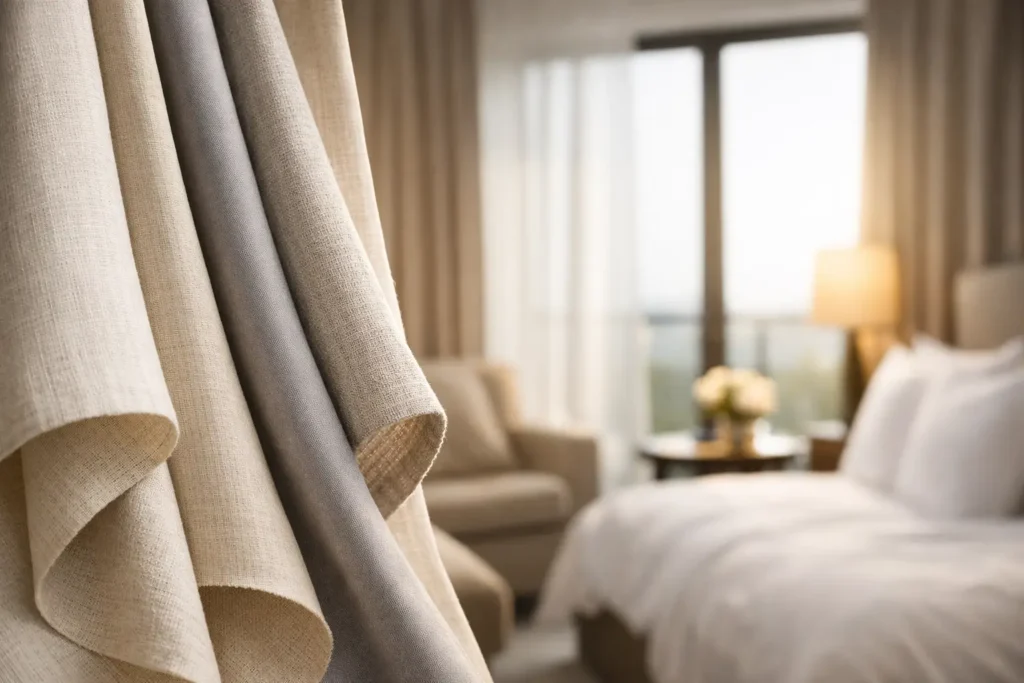
A hotel curtain is handled far more often than a residential curtain. Guests pull it open at sunrise, close it for privacy, brush past it with luggage, and expect it to look immaculate every time. That is why choosing the best fabrics for hotel curtains is not simply a design decision. It affects sleep quality, housekeeping routines, energy comfort, acoustic control, safety compliance, and the lasting impression a room makes.
For hotels, the right fabric must work hard without looking utilitarian. It should drape beautifully, withstand frequent cleaning, manage intense daylight, and support the character of the property, whether that is a sleek business hotel, a relaxed resort, or a high-end boutique stay. The strongest specification usually combines a practical blackout layer with a lighter decorative sheer, tailored and fitted precisely for the window.
What Hotel Curtain Fabric Needs to Do
A fabric that looks impressive on a small sample can behave very differently across a full-height hotel window. Before selecting color or texture, consider how the curtain will perform day after day.
Durability is essential. Hotel curtains face repeated opening and closing, regular laundering or professional cleaning, and prolonged sun exposure. Fabrics with a stable weave and strong fibers hold their shape better, resist snagging, and retain a polished appearance after maintenance.
Privacy and light control matter just as much. Guest rooms need reliable darkness for sleep, particularly in urban locations with bright street lighting. Public areas, on the other hand, may benefit from filtered daylight that reduces glare without closing a space off from its view.
Safety cannot be treated as an afterthought. Hotel curtain fabrics should meet the applicable fire-retardant requirements for the project and location. Ask for clear documentation from the supplier, especially when choosing imported textiles or specifying curtains for a large hospitality development.
Finally, consider maintenance from the start. A fabric that requires delicate handling may not suit a high-occupancy property, no matter how luxurious it feels. The best choice balances visual refinement with a realistic cleaning schedule and replacement cycle.
Best Fabrics for Hotel Curtains by Performance
Blackout Polyester: The Reliable Guest Room Choice
Blackout polyester is one of the most practical fabrics for hotel bedrooms. It is durable, cost-effective, color-consistent, and available in a wide range of textures, from smooth contemporary finishes to linen-look weaves. When backed with a proper blackout coating or woven blackout construction, it can block the majority of incoming light and improve guest privacy.
Its main advantage is dependable performance. Polyester resists wrinkling, tolerates regular care well, and is less likely to shrink or lose its shape than many natural fibers. For hotels with many rooms, this consistency makes procurement and future replacements easier.
Not every polyester blackout is equal. Lower-grade coated fabrics can stiffen, crack, or delaminate over time in strong sunlight. A premium contract-grade fabric with tested lightfastness and the correct fire-retardant rating is worth the investment, particularly for large windows in sunny climates.
Dimout Fabric: When Soft Light Is Part of the Experience
Dimout fabrics reduce daylight significantly but do not create full darkness. They are an excellent option for lounges, restaurants, meeting rooms, and suites where a softer atmosphere is preferred during the day. They can also be used in guest rooms when paired with an additional blackout lining.
Many dimout textiles have a refined, woven appearance that feels warmer than a heavily coated blackout fabric. They are especially useful in spaces where the curtain remains visible for much of the day and needs to contribute to the interior design rather than disappear into the background.
The trade-off is straightforward: dimout alone may not satisfy guests who expect complete darkness at night. In bedrooms, test the fabric in the actual room conditions before finalizing the specification.
Wool and Wool-Blend Fabrics: Luxury With Acoustic Benefits
Wool and wool-blend curtains bring depth, warmth, and a noticeably elevated finish to premium hotel interiors. Their natural texture works beautifully in boutique hotels, executive suites, refined lobbies, and spaces designed around a residential feel. Wool also offers useful acoustic properties, helping soften echoes and improve the sense of quiet in large rooms.
Pure wool can be more demanding to maintain and may carry a higher upfront cost. For this reason, wool blends are often the more practical hospitality choice. Blending wool with performance fibers can improve durability, stability, and cleanability while preserving the fabric’s rich look and soft drape.
This is a fabric worth considering where design and comfort are central to the guest experience. It is less suitable for every high-turnover room unless the hotel is prepared for the care requirements and chooses a tested contract-quality blend.
Velvet: A Strong Statement for Premium Spaces
Velvet curtains instantly create a sense of drama and comfort. They are a natural fit for luxury suites, formal reception areas, private dining spaces, theaters, and heritage-inspired hotel interiors. The dense pile gives velvet visual richness while also helping absorb sound and reduce the hard, echoing feel of expansive rooms.
For hotel use, performance velvet is usually the smarter option than delicate decorative velvet. Look for durable synthetic or blended velvets designed to resist crushing, fading, and frequent handling. A lined velvet curtain can provide excellent insulation and light control, but it will be heavier, so the track, brackets, and installation must be specified accordingly.
Velvet is not the answer for every room. In casual, minimalist interiors, it can feel overly formal. It also needs careful cleaning to keep the pile looking even. Used selectively, however, it adds a level of hospitality luxury few other fabrics can match.
Linen-Look and Linen-Blend Fabrics: Relaxed, Tailored Elegance
Linen-look polyester and linen-blend fabrics give hotels the easy, natural character many modern guests appreciate. They are ideal for resort-style rooms, coastal concepts, wellness spaces, and contemporary suites that need softness without excessive ornament.
Pure linen has a beautiful, organic irregularity, but it wrinkles easily and can be prone to shrinkage. For most hotels, a linen-look performance fabric delivers the better balance. It captures the texture of linen while offering more stable dimensions, easier maintenance, and stronger resistance to daily use.
A linen-look sheer paired with a blackout curtain is a particularly effective hotel treatment. The sheer provides daytime privacy and filtered daylight, while the blackout layer gives guests the darkness they expect at night.
Sheer Polyester: Essential for Daytime Privacy
Sheers are often overlooked because they are not responsible for blackout performance, yet they are key to how a hotel room feels during the day. A quality sheer softens harsh sunlight, maintains a connection to the view, and gives guests privacy without making the room dark.
Polyester sheers are widely used because they are lightweight, durable, and easier to maintain than fragile natural-fiber alternatives. Modern options range from clean, almost invisible voile to textured woven sheers that add subtle depth to the room.
For windows exposed to strong sun, select a sheer with good UV stability. The fabric should be full enough to look elegant when closed, but not so dense that it blocks the daylight guests value in the morning.
Choose Fabric With the Full Curtain System in Mind
The fabric is only one part of hotel curtain performance. A blackout curtain can still allow unwanted light around the edges if the track is poorly positioned or the curtain does not have sufficient fullness. Likewise, a heavy luxury fabric will not operate smoothly on an undersized track.
For guest rooms, a double-track setup is often the most flexible solution: a sheer on one track and a blackout or dimout curtain on the other. This gives guests complete control over privacy and daylight. Ceiling-mounted tracks also create a more tailored, high-end finish and can reduce light gaps compared with a standard wall-mounted rod.
Motorized curtains may be appropriate for premium suites, accessible rooms, or properties seeking smart-room convenience. In these settings, fabric weight, stack-back space, and track quality should be reviewed together so the system remains quiet and reliable.
Color, Pattern, and Maintenance Considerations
Neutral fabrics remain popular in hotels because they age well, coordinate easily with future furniture updates, and create a calm backdrop for guests. Warm grays, sand tones, stone, taupe, muted blue, and soft charcoal can all feel sophisticated without showing every minor mark.
Pattern has its place, especially in boutique properties, but an oversized or highly directional design can complicate fabrication and future replacement. If patterned fabric is used, allow for pattern matching and consider whether the design will still feel current after several years.
For long-term value, request fabric samples and evaluate them under the room’s actual lighting. Review their fire-retardant documentation, cleaning guidance, lightfastness, and recommended use. A professional site measurement is equally valuable because it determines the fullness, drop, track position, and side returns that make a curtain look considered rather than merely installed.
At Elegant Blinds & Curtains, hotel curtain projects are planned around the room, the operating demands, and the desired guest experience. From selecting premium blackout and sheer combinations to precise tailoring and professional installation, the goal is a finish that looks exceptional from check-in to checkout. Schedule a measurement and fabric consultation to create window treatments that give every guest room the comfort, privacy, and quiet luxury it deserves.