
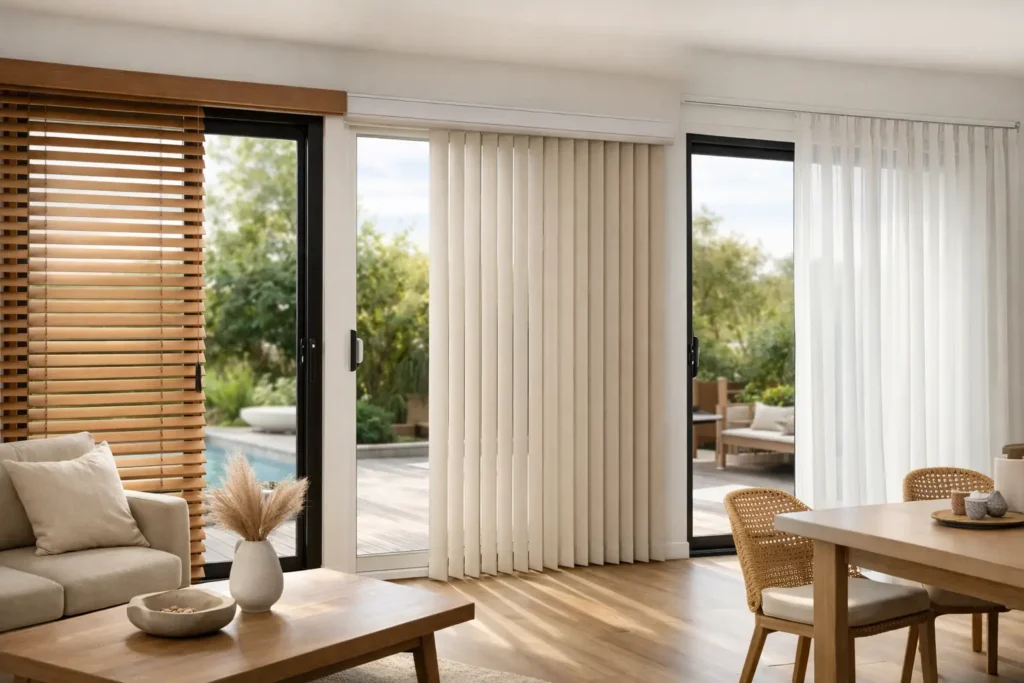
A sliding glass door can be the brightest feature in a room and the most demanding one to dress. The best blinds for sliding doors need to do more than look refined: they must move easily with the door, control strong daylight, protect privacy after dark, and fit the opening with precision. A standard, off-the-shelf solution often falls short, especially on wide patio doors, balconies, or floor-to-ceiling glass.
The right choice depends on how the door is used, how much sunlight reaches the room, and the look you want to create. For a sleek apartment living room, a hotel-style suite, or a busy office entrance, custom-fitted blinds make the everyday experience feel considered rather than compromised.
What Sliding Doors Need From a Window Treatment
Unlike a fixed window, a sliding door is an active passageway. Its treatment should stack neatly away from the opening, avoid dragging across the floor, and allow people to pass through without constant adjustment. This is why the orientation and operating mechanism matter as much as the fabric or color.
Privacy is another key consideration. Large glass panels can leave a room exposed at night, while direct sun can create glare, heat, and faded furnishings during the day. A well-selected blind gives you control at different times of day rather than forcing you to choose between daylight and comfort.
Before selecting a style, consider four practical details:
- Which panel moves and which panel remains fixed
- Whether the door opens to a balcony, garden, terrace, or high-traffic area
- How much direct sun and heat the glass receives
- Whether you need daytime privacy, complete blackout, or flexible light filtering
Accurate measuring is essential. The track, stacking space, ceiling height, handles, and nearby furniture all affect how a blind should be specified and installed.
Best Blinds for Sliding Doors by Style
Vertical Blinds for Wide, Practical Coverage
Vertical blinds remain a smart choice for large sliding doors because their panels move in the same direction as the door. They can open to the left, right, or split in the center, making them especially practical when one side is used more often than the other.
Their rotating vanes also offer adjustable light control. Tilt them slightly to soften bright afternoon sun while still retaining a view, then close them for added privacy. Modern vertical blind collections have moved well beyond the office look, with textured fabrics, soft neutrals, and refined finishes that suit contemporary homes.
The trade-off is that vertical blinds have a more structured appearance than curtains or panel tracks. They are ideal for clients who prioritize easy access and directional light control, particularly in living rooms, offices, and commercial spaces.
Panel Track Blinds for a Clean, Architectural Look
Panel track blinds are one of the most elegant options for broad sliding glass doors. Wide fabric panels glide along a discreet track and stack behind one another when open. The result is calm, tailored, and uncluttered – an excellent match for minimalist interiors, modern villas, and hospitality spaces.
Because the panels are larger than vertical vanes, they create a smoother visual surface when closed. Choose sheer or light-filtering fabric to preserve a bright, airy mood, or select blackout material for stronger privacy and light reduction. Panel tracks can also be made in coordinated fabrics, allowing the sliding door treatment to complement curtains, upholstery, or other interior finishes.
They do need clear wall or ceiling space for stacking. A professional site measurement confirms that the panels will park neatly without blocking the door or competing with adjacent furniture.
Roller Blinds for Simple, Modern Light Control
Roller blinds suit sliding doors when a clean, compact finish is the priority. They are particularly effective for fixed glass panels beside a sliding section, or for doors where each panel can be treated individually. With sunscreen fabric, roller blinds reduce glare and UV exposure while maintaining an outward view during daylight hours.
For bedrooms, media rooms, or spaces that need stronger darkness, blackout roller blinds are a more suitable choice. They offer a crisp, contemporary appearance and are easy to pair with curtains for a layered finish. The curtains bring softness and decorative impact, while the roller blind handles privacy and light control.
The limitation is access. A roller blind must be raised before opening the door behind it, so it is not always the most convenient standalone solution for a frequently used balcony door. It works best where the door is used occasionally or where automation makes operation effortless.
Zebra Blinds for Flexible Day-to-Night Privacy
Zebra blinds use alternating sheer and opaque fabric bands to create adjustable light control. By aligning the layers, you can filter daylight or close the opaque sections for increased privacy. Their polished, contemporary design makes them popular in apartments, bedrooms, and office interiors.
On sliding doors, zebra blinds are most effective when fitted to individual panels or used on fixed sections around the door. They give a more decorative look than a standard roller blind, but they still need to be lifted to allow full access through the opening. For doors used every day, they are often best paired with a separate solution for the active panel.
Venetian Blinds for Precise Glare Management
Aluminum, wood-look, or faux wood Venetian blinds give detailed control over light direction. Their horizontal slats can angle sunlight upward, reduce glare on screens, and maintain a degree of daylight without leaving the room fully exposed.
They are a strong option for office doors, kitchen-adjacent patios, and rooms where screen glare is a concern. However, on very wide doors, horizontal slats can feel visually busy and may be less convenient than vertical options. They also require more care when cleaning than a smooth fabric panel.
Motorized Blinds Make Sliding Doors Easier to Live With
Large glass doors are among the best places to introduce motorization. A motorized blind or panel track can be operated by remote, wall switch, or smart-home control, eliminating the need to reach across wide glass panels or handle cords and chains.
Automation is especially valuable for tall doors, difficult-to-reach tracks, and rooms that receive intense sun at predictable times. You can schedule blinds to close during the hottest part of the afternoon, open in the morning, or adjust with a single touch before settling in for the evening.
For family homes and hospitality environments, cordless motorized operation also provides a cleaner finish and reduces loose-control concerns. The initial investment is higher than manual operation, but the convenience, refined appearance, and daily usability can make it worthwhile.
Choosing Fabric and Color for the Room
The fabric changes how the entire door feels in the room. Sheer and sunscreen materials work beautifully where you want daylight and an open view, such as a living room overlooking a balcony. Light-filtering fabrics soften harsh sun without creating a heavy atmosphere.
Blackout fabrics are better for bedrooms, nurseries, media rooms, or spaces facing bright exterior lighting. Keep in mind that blackout fabric alone may not create complete darkness if light escapes around the sides of the blind. The track design, mounting position, and any layered curtains all influence the final result.
For color, warm whites, sand, taupe, and soft gray create a timeless backdrop and help large glass doors feel integrated into the interior. Darker shades make a stronger design statement and can reduce visible glare, but they may absorb more heat in sun-facing rooms. A fabric sample viewed against the actual glass is far more reliable than choosing from a screen image.
Custom Fitting Is What Gives the Finish Its Value
Sliding door blinds are not a one-size-fits-all purchase. Even doors that appear similar can have different tracks, handle positions, ceiling drops, recess depths, and usable stacking areas. A few millimeters can affect whether the blind clears the door, closes properly, or looks aligned.
At Elegant Blinds & Curtains, a professional measurement and consultation help match the treatment to the way you use the room, not simply the dimensions of the glass. This is where a practical vertical blind can become a tailored design feature, or where a motorized panel track can be specified to disappear neatly when the door is open.
The most beautiful sliding door treatment is the one you barely have to think about. It should glide when you need access, soften the light when the sun is high, and make the room feel private and finished when evening arrives. Schedule a measurement before deciding, and let the door’s movement, light, and surroundings guide the final choice.