
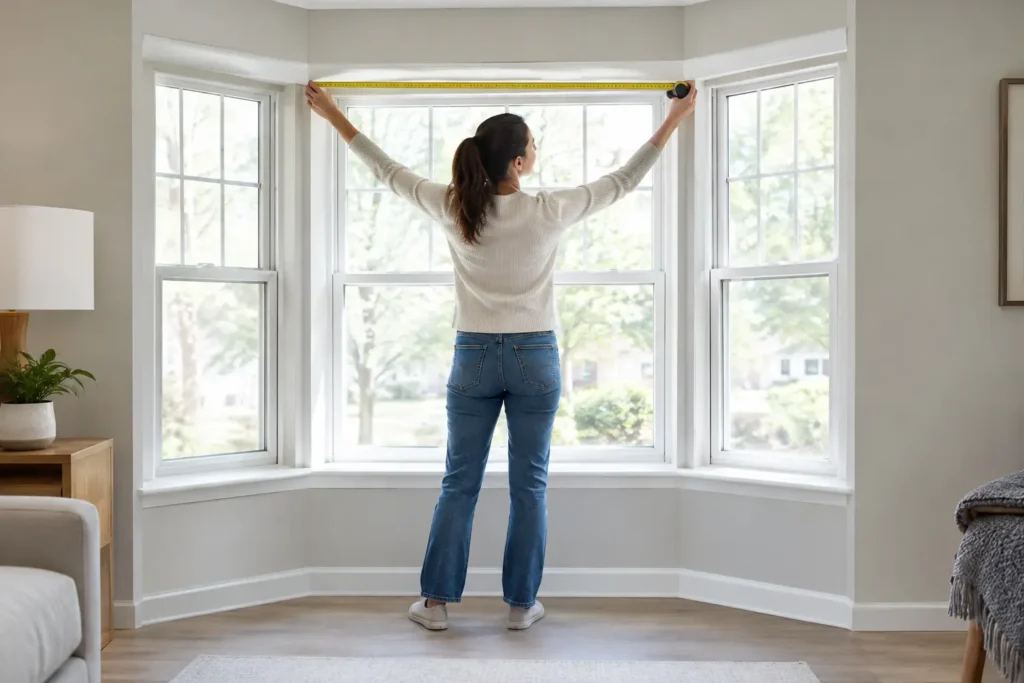
A bay window can become the most striking feature in a room, but only when its curtains or blinds follow the shape with precision. Learning how to measure bay windows before choosing fabrics, tracks, or blinds helps avoid common disappointments: panels that block too much glass, poles that collide at the corners, and treatments that sit awkwardly above the frame.
Bay windows are not measured like a standard flat window. They have multiple faces, changing angles, and often a sill, radiator, seating area, or furniture to consider. The right dimensions depend not only on the window itself, but also on whether you want curtains, roller blinds, Roman blinds, Venetian blinds, or a motorized solution.
Start With the Window Treatment, Not the Glass
The first decision is where your treatment will sit. This determines every measurement that follows.
For curtains, the most elegant finish is usually achieved by measuring for a track or pole mounted above and around the bay, rather than measuring the glass. This gives the room a taller, more luxurious appearance and allows curtains to clear the window when open. If you want to preserve a built-in bench, keep access to the sill, or fit blinds within each section, an inside-frame measurement may be more practical.
There is no universal “best” position. A floor-length blackout curtain creates softness, privacy, and strong light control in a bedroom or living room. Separate blinds on each pane offer a cleaner, more architectural look for kitchens, offices, and compact spaces. In many premium interiors, the answer is both: functional blinds for daytime control with curtains to add texture and visual warmth.
Before measuring, decide whether the finished treatment will be face-mounted above the bay, fitted inside each recess, or installed across the front of the entire bay. If you are considering motorized curtains or blinds, allow space for the motor, brackets, and a clear operating path from the beginning.
Tools You Need to Measure a Bay Window
Use a metal tape measure rather than a soft sewing tape, as it stays straight and gives more reliable readings. Keep a pencil, paper, and a phone camera nearby. A step stool is useful for high mounting positions, while a laser measure can help with larger villas or commercial spaces, though it should not replace checking critical points by hand.
Take your measurements in millimeters where possible. Custom-made window treatments are fabricated to close tolerances, and a small difference can affect how the corners meet or how a blind operates.
How to Measure Bay Windows for Curtains
For a traditional three-sided bay, measure each wall section separately: the left return, the center section, and the right return. Do not measure only the width across the front. That single number does not account for the side angles or show where brackets and curtain returns need to sit.
Measure the intended track or pole line
Decide how far above the window the track or pole will be installed. A position around 4 to 8 inches above the highest point of the frame is often visually pleasing, provided there is enough wall space. Higher placement can make ceilings feel taller, while a lower placement may be necessary beneath a soffit, air-conditioning grille, or ceiling detail.
Mark the proposed mounting line lightly on the wall. Then measure along that line from the outer end of the left section, across the center, and to the outer end of the right section. Record each straight section individually.
For example, your bay might have a 22-inch left section, a 58-inch center section, and a 22-inch right section. Those measurements help a professional specify a bent track, segmented pole, or individual curtain rods with the correct corner connections.
Allow the treatment to extend beyond the window frame where space permits. This enables curtains to stack back from the glass, preserving daylight and the view when they are open. In a narrow bay, however, extending too far can make the room feel crowded or cause fabric to brush furniture. This is one of the details where proportion matters more than a fixed rule.
Record the corner angles
Most bay windows are not made with identical angles. The side sections may meet the center at 90, 135, or another custom angle. Measure the angle with an angle finder if available, or photograph each corner from above and note the shape carefully.
This step is especially important for curtain poles and bent tracks. A track can be professionally shaped to follow the bay, but the installer needs accurate information to produce smooth movement through every corner. If the corners are tight, curtains may not travel fully around them. In that case, separate panels or a center-opening design can be the better choice.
Measure curtain drop from the mounting point
Curtain drop is the vertical measurement from the underside of the track or pole rings to the desired finished length. Take this measurement in at least three places: left, center, and right. Floors in apartments, villas, and older properties are not always perfectly level.
For a polished floor-length finish, stop around 1/2 inch above the floor. For a more relaxed, decorative look, curtains can lightly touch or puddle on the floor, although this is less practical in dusty areas, children’s rooms, or busy hospitality settings. If there is a radiator beneath the window, sill-length curtains or blinds may provide better airflow and a cleaner fit.
When measuring above a window seat, decide whether curtains should finish above the seat, skim the cushion, or run to the floor at the outer sides. Each option creates a different look, so it is worth viewing fabric samples against the room before confirming the final drop.
Measuring a Bay Window for Individual Blinds
Blinds are usually measured one section at a time. This applies to roller blinds, zebra blinds, Roman blinds, Venetian blinds, and many motorized systems.
For inside-mounted blinds, measure the width at the top, middle, and bottom of each recess. Use the smallest width, because the recess may taper slightly. Then measure the drop on the left, center, and right, using the shortest drop if the manufacturer requires a clearance deduction. Also check the recess depth. Some blind mechanisms need more depth than others, particularly layered zebra blinds and motorized products.
For outside-mounted blinds, measure the area you want the blind to cover rather than just the glass. Add overlap beyond each side of the window for improved privacy and light control. The amount depends on handles, trim, nearby walls, and whether neighboring blinds need to operate without touching. Measure from the desired top mounting point to the preferred bottom point, then confirm that the bracket location is solid and unobstructed.
At the angled joins of a bay, leave enough clearance for blind brackets, chains, wands, or motor housings. Treatments that look perfect on a front elevation can interfere with one another when viewed from the side. This is why separate measurements and a practical clearance check are essential.
Check Obstacles Before You Finalize Dimensions
Bay windows often have more interruptions than expected. Window handles may project into the blind path. Opening casements can hit a roller blind. Air-conditioning vents, cornices, decorative molding, curtain pelmets, and sprinkler heads can limit where a track is installed.
Look at the room in use, not just the empty window. Check where a sofa, dining table, bedside table, or desk will sit. Consider whether curtains need to clear balcony doors or whether blinds must be raised for windows to open. For automated treatments, identify the power source and whether you prefer wall controls, remote control, or smart-home integration.
These checks may lead to a different product choice. A beautiful full-width curtain track may be ideal for a formal living room, while individually fitted motorized roller blinds may make more sense for a sun-facing office where precise glare control matters every day.
Common Bay Window Measuring Mistakes
The most frequent mistake is measuring the glass instead of the planned treatment position. Another is assuming both angled sides are identical without checking. It is also easy to measure only one curtain drop, overlook a protruding handle, or forget the space needed for curtain stacking.
Avoid ordering based on rough estimates or a photograph. Bay windows reward accuracy, and premium fabrics or custom mechanisms leave little room to correct a measurement after fabrication. A professional site visit is particularly valuable for oversized bays, ceiling-mounted tracks, double-layer curtains, and motorized installations.
When Professional Measurement Is the Better Choice
If your bay window has unusual angles, a curved wall, high ceilings, or multiple layers of curtains and blinds, professional measurement protects the finished result. An experienced specialist can assess wall strength, track bending, bracket placement, fabric fullness, light gaps, and the practical movement of every panel.
Elegant Blinds & Curtains provides tailored measurement and installation for homes, offices, and hospitality spaces across the UAE. A design consultation can also help you compare blackout curtains, sheer curtains, Roman blinds, roller blinds, and motorized options against the light, privacy, and style requirements of your room.
A well-measured bay window does more than hold a window covering. It frames the architecture, improves comfort, and gives the entire room the composed finish that custom interiors deserve. Schedule a measurement before selecting your final fabric or blind style, and let the proportions of the bay guide a result that feels intentional from every angle.