
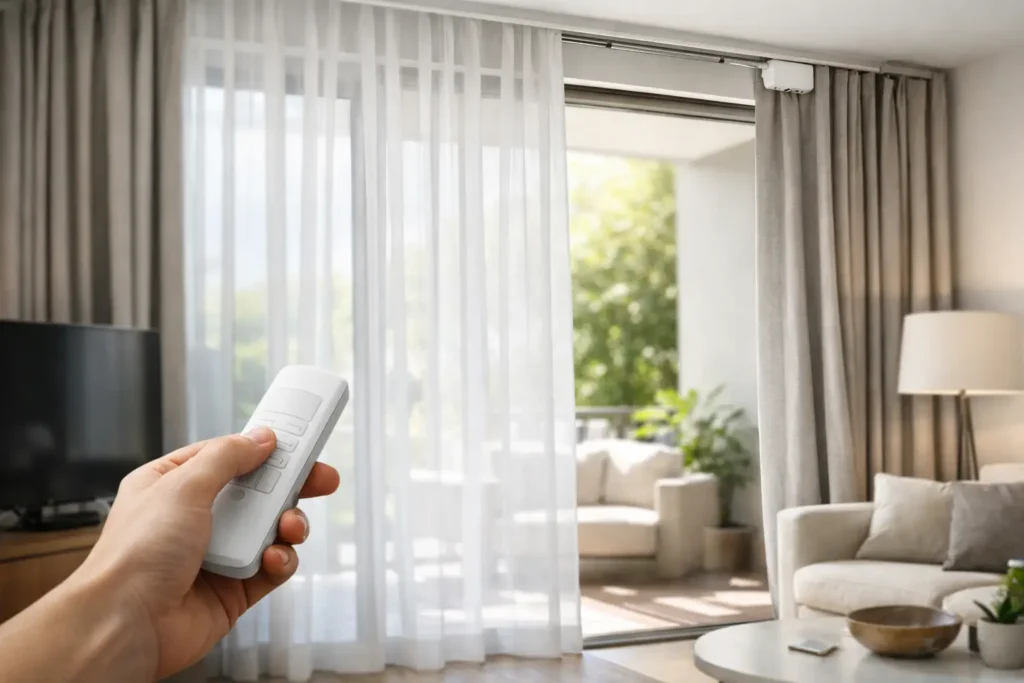
A motorized curtain system review should answer more than one question: can the curtains open at the touch of a button? The real question is whether automation improves the way a room looks, feels, and functions every day. For bedrooms with tall windows, sun-filled living rooms, executive offices, and hotel suites, the answer is often yes – provided the system is correctly specified, custom-fitted, and professionally installed.
Motorized curtains bring together premium fabric, a made-to-measure track, a quiet motor, and controls that suit your routine. They can make a wide window treatment feel effortless rather than heavy, while giving you more precise control of privacy and daylight. But they are not the right choice for every small window or every budget. Here is an honest look at where they deliver the most value and what to consider before choosing one.
What a Motorized Curtain System Actually Includes
The visible curtain is only one part of the installation. Behind it sits a motorized track designed around the window width, curtain heading, fabric weight, and opening style. The motor moves the curtains from one side, from the center, or toward the center, depending on the layout you choose.
Most systems can be operated with a wall switch, remote control, smartphone app, or a compatible smart-home platform. Timers and scenes are particularly useful: sheer curtains can open in the morning, blackout drapes can close before bedtime, and both layers can be adjusted for entertaining or movie viewing without leaving the sofa.
The quality of these components matters. A beautiful blackout curtain will not perform well on an undersized track, and a capable motor can still feel disappointing if the curtain stacks unevenly or catches on a poorly measured return. This is why custom fabrication and fitting are central to the final result, not optional extras.
Motorized Curtain System Review: The Everyday Benefits
Better light control without the effort
The strongest reason to choose motorization is simple convenience, especially on large, wide, or hard-to-reach windows. A manual curtain may be easy to use at a standard window. At a double-height glass wall, behind a bed, or across a sliding door, it can become something people leave in one position for days.
With automation, the curtains are more likely to be used as intended. Sheers can filter harsh daylight while preserving a soft, open feel. Blackout curtains can close fully when privacy, rest, or glare reduction is needed. In bright climates such as Dubai, scheduled closing can also reduce direct afternoon sun before a room becomes uncomfortable.
A more polished finish
There is a noticeable visual difference between manually pulled curtains and curtains that move evenly along a tailored track. Motorized systems create a controlled, hotel-inspired effect: the fabric glides into clean folds, the opening is consistent, and there is no need to handle delicate materials repeatedly.
This is especially valuable with full-height curtains, wave headings, lined drapery, and layered sheer-and-blackout designs. The system keeps the room looking considered even during busy mornings, guest arrivals, or office operating hours.
Privacy and comfort on your schedule
Automation is useful when privacy changes throughout the day. A ground-floor apartment, villa, meeting room, or hospitality space may need daylight in the morning and coverage after sunset. Rather than relying on someone to adjust every curtain manually, scheduled operation creates a reliable routine.
For bedrooms, a programmed blackout curtain can support a calmer evening environment. For offices, closing curtains during screen presentations helps manage glare without interrupting a meeting. In hotel rooms, quiet motorized drapery adds a premium detail guests recognize immediately, even if they do not think about the technology behind it.
Smart-home compatibility that has a purpose
Smart controls are appealing, but they should solve a real daily need. Voice control can be useful when hands are full. App control is practical when you want to close curtains remotely or manage several rooms from one place. Integration with lighting, air conditioning, and home scenes can make the space feel coordinated.
Still, the best system is not necessarily the one with the longest feature list. A simple remote and wall switch may be ideal for a guest room or rental property. A fully integrated smart-home setup may make more sense for a villa, a new build, or a commercial project with multiple window zones.
Where Motorized Curtains Have the Most Value
Motorization delivers the greatest return where manual operation is inconvenient or where the curtains are part of the room’s daily performance. Large living-room glazing, tall stairwell windows, master bedrooms, media rooms, boardrooms, and hotel suites are strong candidates.
They also suit layered window treatments particularly well. For example, a sheer curtain can remain closed during the day to soften sunlight, while a separate blackout layer closes in the evening. With dual-track motorization, both fabrics can be controlled independently, giving the room a refined balance of openness and privacy.
For a single small window that is rarely covered, manual curtains may be the more sensible choice. The same applies when a client values a traditional pull-cord or hand-drawn experience over automation. Premium interiors should feel personal, not overly technical.
The Trade-Offs to Consider Before Buying
A fair review must include the limitations. Motorized curtains cost more than manual curtains because they require a motor, specialized track, controls, power planning, and careful installation. The investment becomes easier to justify when the curtains are large, heavy, frequently used, or installed in multiple rooms.
Power is another decision. Hardwired systems offer a clean, permanent solution and are often preferred during construction or renovation, when wiring can be concealed. Battery-powered options can be useful where adding electrical points is difficult, but batteries need periodic charging or replacement. The right option depends on access, usage, and how minimal you want the final finish to be.
Noise levels also vary by system and fabric weight. Quality motors are designed for quiet operation, but no moving curtain is completely silent. In bedrooms and hospitality spaces, selecting a suitable motor and correctly balancing the fabric weight makes a meaningful difference.
Finally, automation does not correct poor curtain design. If the fabric is too light for the desired blackout level, if the track is mounted too close to a window handle, or if the stack-back area is not planned, motorization will only make those shortcomings more obvious. Consultation and exact measurement protect the investment.
Choosing the Right System for Your Space
Start with the room, not the motor. Decide what you want the curtains to do: darken the room, filter daylight, improve privacy, reduce glare, frame a view, or add softness to a modern interior. Then select the fabric, lining, heading, and track configuration that support that purpose.
A bedroom may benefit from blackout curtains on a motorized track with a remote near the bed. A living room may call for motorized sheers with blackout drapery behind them. An office may need durable fabric, straightforward controls, and grouped operation for several windows. Each setting has different priorities, which is why one-size-fits-all packages often fall short.
Measure the full area around the window, not only the glass. The curtain needs adequate overlap for privacy and light control, enough clearance to move freely, and a considered place to stack when open. Ceiling-mounted tracks often create the most luxurious full-height appearance, while wall-mounted options can work well where ceiling details or access make them more practical.
Installation Is What Makes the System Feel Premium
A motorized curtain system should look effortless after installation, but achieving that finish requires planning. The track must be level, securely fixed, and positioned to avoid rubbing against walls, handles, air-conditioning grilles, or decorative ceiling features. The curtains must be tailored to the correct finished drop and fullness, then programmed and tested before handover.
Elegant Blinds & Curtains approaches this as a complete service, from consultation and free measurement through fabric selection, custom tailoring, professional fixing, and control setup. That matters because one team can coordinate the visual and technical details instead of leaving you to manage separate suppliers.
A well-chosen motorized curtain system is less about adding a gadget and more about making beautiful window treatments easier to enjoy. Book a measurement appointment when you are ready to see how the right fabric, track, and controls can transform your room with one quiet touch.