
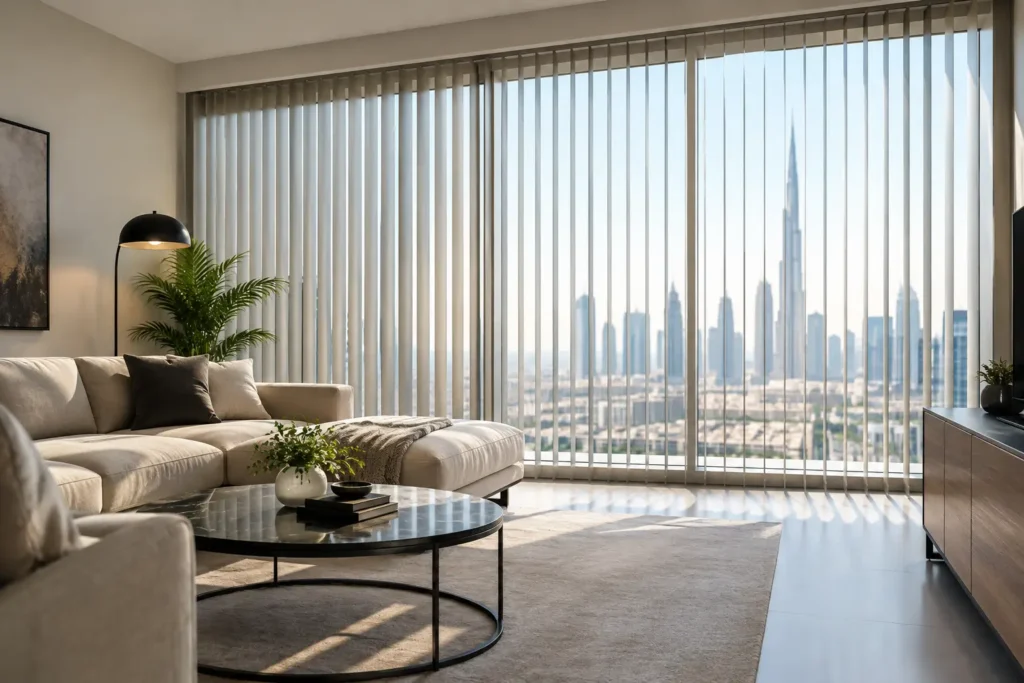
A sun-facing living room, a floor-to-ceiling office window, or a sliding balcony door can look unfinished when the window treatment is an afterthought. Vertical blinds solve that problem with crisp architectural lines, flexible privacy, and practical control over Dubai’s intense daylight. When they are made to measure and professionally installed, they do more than cover glass. They give the entire room a composed, polished finish.
For homeowners, offices, and hospitality spaces, their appeal is simple: vertical blinds suit wide openings exceptionally well. The individual slats can be tilted to soften glare while preserving daylight, then drawn aside when a clear view is the priority. The result is a tailored treatment that feels refined without competing with the rest of the interior.
Why Vertical Blinds Work So Well on Large Windows
Large windows are a design advantage, but they bring real comfort considerations. Strong sun can create glare on television screens and computer monitors, raise perceived heat near the glass, and reduce privacy after dark. Curtains can provide a luxurious, layered look, but they may feel too full in a compact office or a contemporary apartment. Roller blinds offer a clean profile, yet they cannot always provide the same directional control of light.
Vertical blinds sit comfortably between those options. Their vertical vanes rotate to direct light upward, downward, or away from the room. During the day, this allows natural light to enter with less harshness. At night, closing the vanes improves privacy without making the window feel heavy.
They are particularly suited to patio doors, sliding doors, full-height windows, meeting rooms, reception areas, and wide bedroom openings. Because the blind stack opens to one side or splits in the center, access to a door can be planned around how the space is actually used. That detail matters. A blind that looks good but blocks the route to a balcony quickly becomes frustrating.
Choosing Vertical Blinds for Each Room
The right fabric, color, and operating style depend on the room’s purpose. A soft textured fabric can bring warmth to a living room or bedroom, while moisture-resistant PVC vanes are often more practical for kitchens, utility areas, and bathrooms. In a professional office, neutral fabric vertical blinds can reduce screen glare and create a calm backdrop for clients and team members.
For bedrooms, consider a denser fabric with strong light filtering or blackout performance. No blind should be selected on appearance alone when sleep quality is a concern. The direction of the window, the amount of surrounding light, and whether the room needs complete darkness all influence the best choice. In some spaces, vertical blinds work beautifully alongside blackout curtains, combining precise daytime control with a softer luxury finish at night.
Color deserves the same attention as fabric. White and warm beige keep a room bright and understated. Gray, taupe, and stone shades suit modern apartments and commercial interiors, especially where furniture and flooring already carry the visual interest. Darker tones make a stronger statement, but they may reveal dust more easily and can make a smaller room feel more enclosed. A design consultation helps balance the desired look with everyday upkeep.
Fabric, PVC, and Faux Wood Options
Fabric vanes are often the most versatile choice for residential interiors. They offer visual softness, a broad selection of textures, and a more decorative appearance than standard office blinds. Quality fabric also helps diffuse daylight gracefully, rather than simply shutting it out.
PVC vertical blinds are durable, easy to wipe down, and a sensible option in areas exposed to humidity or frequent splashes. They are popular in practical settings, but the finish should be selected carefully to avoid an overly basic look. Premium PVC in a clean matte tone can still look sharp and contemporary.
Faux wood styles provide a more substantial appearance and can complement wood-effect flooring, neutral wall panels, or classic interiors. They are not the automatic answer for every wide window, however. Heavier materials need the correct track, secure fixing, and thoughtful consideration of the opening size. Custom advice is valuable here because the most attractive material on a sample board is not always the best-performing choice for a particular window.
The Difference Custom Measurement Makes
Vertical blinds are defined by alignment. Even an elegant fabric can look disappointing if the track is uneven, the vanes are too short, or the stack obstructs a door handle. Made-to-measure fitting is what gives the treatment its premium appearance.
A professional measurement considers more than width and drop. It accounts for the ceiling height, the depth of the recess, nearby furniture, air-conditioning vents, door swing, handles, and whether the blind should sit inside or outside the window recess. It also determines the best opening direction. For a sliding door, the vanes should stack away from the active entrance. For a corner window, the two treatments need to meet neatly without leaving awkward gaps.
In Dubai villas and apartments, ceiling-mounted tracks are often chosen to emphasize height and create a cleaner line. Wall-mounted systems can be better where the ceiling has a bulkhead, limited fixing space, or architectural features that need to remain visible. There is no universal right choice. The right installation is the one that makes the room function better and looks intentional from every angle.
Light Control, Privacy, and Energy Comfort
Vertical blinds are not a replacement for insulated glazing or air conditioning, but they can contribute to a more comfortable room by reducing direct solar exposure. Tilting the vanes away from the strongest sun helps reduce glare and can make seating areas more pleasant during bright afternoon hours.
Their greatest strength is adjustability. Fully open, they frame the view and make the window feel expansive. Partially tilted, they create privacy while retaining daylight. Fully closed, they offer a more protected and focused atmosphere. This flexibility is useful in offices where presentation screens are used throughout the day, as well as in homes where a room needs to shift from daytime brightness to evening privacy.
If complete darkness is essential, ask about blackout fabric options and the realistic level of light control possible around the sides and top of the blind. Any window treatment with moving components has small gaps, especially when installed inside a recess. A layered solution, such as vertical blinds with blackout curtains, may be the stronger choice for a media room or a light-sensitive bedroom.
Manual or Motorized Operation?
Manual vertical blinds remain a practical, reliable option for most rooms. A wand-operated system gives a neat appearance and avoids loose cords, making it a sensible choice for family spaces. For windows that are easy to reach, manual control is straightforward and cost-effective.
Motorized blinds are worth considering for tall windows, difficult-to-reach glazing, executive offices, and smart-home interiors. With the right system, the blinds can be controlled by remote, wall switch, or compatible automation settings. Scheduled operation can be especially useful for managing sunlight during the hottest hours or maintaining privacy in a commercial space after business hours.
Automation should be planned early when possible. Power access, track position, window dimensions, and the desired control method all affect the installation. A well-planned motorized system feels effortless in use, but it depends on accurate specification before fitting begins.
Caring for Vertical Blinds Without Damaging Them
Vertical blinds are relatively easy to maintain when cleaning becomes part of a regular routine. Use a soft duster or the brush attachment on a vacuum at low suction to remove dust from fabric vanes. Work from top to bottom and avoid pulling or twisting the slats. For PVC vanes, a lightly damp microfiber cloth is usually enough for routine cleaning.
Avoid harsh chemicals, excessive water on fabric, or forcing a vane that is caught or misaligned. If the blinds stop rotating smoothly, the issue may be a carrier, chain, or track component rather than the vane itself. Prompt professional attention can prevent a small operational issue from becoming a full replacement job.
A Tailored Finish for Homes and Workplaces
The most successful window treatments do not announce themselves loudly. They make the daylight feel better, give the room privacy when needed, and support the design rather than distracting from it. Vertical blinds deliver exactly that when their material, opening direction, and installation are chosen with care.
Elegant Blinds & Curtains provides custom consultation, measurement, fabrication, and professional fitting for residential and commercial projects across the UAE. Schedule a free measurement to see fabric samples in your own light, discuss manual or motorized options, and choose a finish that makes every wide window feel considered rather than complicated.