
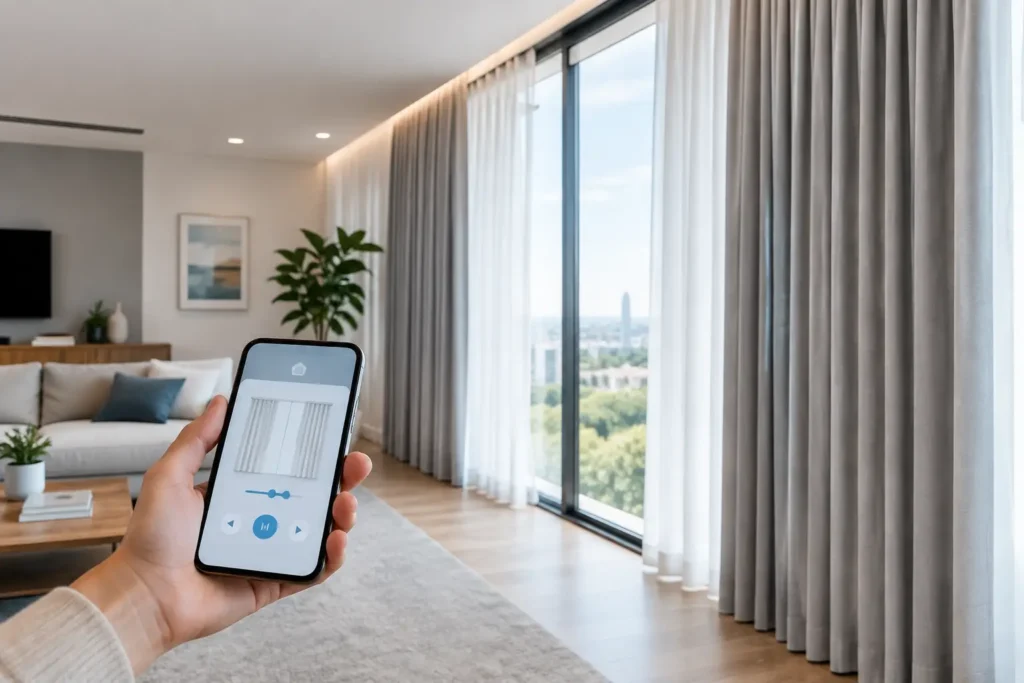
The morning sun in a Dubai-facing bedroom can turn beautiful views into glare within minutes. The future curtain automation responds to moments like this with more than a remote control: it gives homeowners, offices, and hospitality spaces precise control over light, privacy, comfort, and atmosphere. At the touch of a button, on a schedule, or through a smart-home command, curtains can move exactly when the room needs them to.
For premium interiors, this shift matters. Window treatments are no longer a finishing detail that stays in one position all day. They are becoming an active part of how a space feels, performs, and welcomes the people inside it.
Why Future Curtain Automation Is More Personal
The most appealing automation is not about adding technology for its own sake. It is about removing small daily inconveniences while preserving the softness and elegance of beautifully tailored curtains. A wide curtain wall, a double-height window, or a layered sheer-and-blackout arrangement can be difficult to operate by hand. A discreet motor makes that experience effortless without changing the visual character of the room.
Automation also makes rooms more responsive to real routines. Sheer curtains can open gradually in the morning, allowing daylight to enter without the abrupt exposure of fully open windows. Blackout curtains can close before a child’s bedtime, before a presentation begins in an office, or when guests arrive at a hotel suite. In a living room, layered curtains can move from filtered daytime light to evening privacy in seconds.
This is why made-to-measure design remains central. The motor is only one component. Fabric weight, curtain heading, track quality, window width, ceiling height, and the desired stacking position all influence the final result. A thoughtfully specified system looks calm, quiet, and intentional rather than visibly mechanical.
Smarter Control, Better Everyday Comfort
The next generation of motorized curtains will offer more choice in how a room is controlled. Wall switches and handheld remotes remain practical, especially for guests or family members who prefer simple controls. App-based operation adds flexibility when you are away from home, while voice control can be useful when hands are full or windows are difficult to reach.
Schedules are where automation begins to feel genuinely useful. Instead of remembering to close curtains during the hottest part of the afternoon, a programmed setting can do it automatically. That can help reduce direct sun exposure on furniture, flooring, artwork, and upholstery. In rooms with large glazed areas, closing suitable curtains at the right time may also support a more comfortable indoor temperature.
Sensors will play a larger role as well. Light sensors can trigger curtains based on changing daylight, while temperature and occupancy settings can support more considered energy use. The right setup depends on the room. A bedroom may prioritize sleep and privacy, while a meeting room may need glare control for screens. In hospitality, reliability and easy manual override are often more valuable than a long list of app features.
The goal should always be control that feels natural. If a system is complicated enough that nobody uses it, it has missed the point.
The Quiet Luxury of Well-Designed Motion
Premium automation should be felt more than seen. Modern curtain motors can operate quietly, move smoothly, and sit discreetly behind a pelmet, within a recessed ceiling pocket, or along a carefully fitted track. This allows the fabric to remain the visual focus.
That matters particularly with luxury sheers, wave curtains, and full-height drapery. These treatments depend on even folds and a clean line. A professionally selected track and motor help curtains open and close consistently, protecting the tailored appearance that makes custom work so distinctive.
For villas and larger residences, automation can also solve a practical issue: scale. Tall windows and wide sliding doors often require heavy, generous fabric panels. Manual operation can pull curtains out of alignment over time, especially when different household members use them. Motorized movement reduces unnecessary handling and helps maintain the curtain’s shape.
What the Future Curtain Automation Looks Like by Room
A single automation plan should not be copied across every room. Each space has its own requirements, and the best installations reflect that.
In bedrooms, blackout curtains are often paired with a scheduled opening routine. The curtains can remain closed through the night, then open to a preferred level in the morning. Adding sheers creates a softer transition, giving privacy while still allowing daylight into the room.
Living rooms benefit from flexible layers. Motorized sheer curtains can stay closed during the day to diffuse harsh sunlight, while blackout or lined curtains provide stronger privacy and light control after dark. For entertainment rooms, scene-based controls can close curtains before a movie begins without interrupting the experience.
In offices, motorized roller blinds and curtains support screen visibility, employee comfort, and a more polished client-facing environment. The ideal fabric and openness level depend on window orientation and how often the room uses monitors or presentation screens. A fabric that looks beautiful but does not manage glare well can become a daily frustration.
Hotels and serviced apartments need systems that are simple, durable, and intuitive. Guests should be able to control the curtains immediately, whether through a bedside switch or a clearly labeled remote. Behind the scenes, management may benefit from room-ready settings and reduced wear from manual handling.
Choosing the Right System Before Installation
Motorized curtains are easiest to plan before renovation or interior finishing work, when power points, recessed tracks, and ceiling details can be coordinated neatly. That said, automation can also be added to many completed homes and offices. Battery-powered options and carefully planned wiring can provide excellent results where major construction is not desirable.
The first decision is whether the system should be hardwired, battery-powered, or connected to an existing smart-home platform. Hardwired motors are often well suited to new builds, full renovations, and high-use commercial projects. They offer dependable long-term operation and can be integrated neatly into the electrical plan. Battery-operated motors may be a practical choice for an existing apartment or a single-room upgrade, although batteries will need periodic charging or replacement.
Fabric selection also affects performance. Heavy blackout curtains require a motor and track rated for their weight. Lightweight sheers may need careful track design to keep the movement even and prevent panels from catching. In rooms with strong sunlight, lining and fabric performance deserve as much attention as the control method.
Do not overlook manual override. Power interruptions, guest use, and occasional maintenance are real considerations. A quality system should provide a sensible way to operate the window treatment when automation is temporarily unavailable.
Professional Measurement Makes the Difference
Automation amplifies both good design and poor measurement. A track that is too short, a poorly positioned power source, or insufficient space for curtain stacking can affect the entire look of the window. This is why expert site measurement is not an optional extra for motorized treatments.
A professional consultation considers how far curtains need to draw back, whether they should overlap for better blackout performance, where the motor will sit, and how the control points will be used. It also considers ceiling details, air-conditioning vents, furniture placement, and door access. These details are what separate an installation that merely works from one that looks fully integrated into the interior.
Elegant Blinds & Curtains can coordinate custom fabric selection, accurate measurement, tailored fabrication, motor options, and professional installation in one process. That reduces the need to manage separate suppliers while helping ensure the finished curtains suit both the room and the technology behind them.
Design Will Remain More Important Than Devices
As smart homes become more common, there is a temptation to focus on features alone. But the future of curtain automation is still rooted in design. A system should support the architecture, complement the furniture, and make the space easier to live in. It should not demand attention every time it operates.
For some clients, a simple remote-controlled blackout curtain is exactly right. For others, whole-home scenes that coordinate blinds, curtains, lighting, and climate settings will be worth the additional planning. The right investment depends on how often the room is used, the size and complexity of the windows, and the level of convenience you expect.
Begin with the way you want each room to feel at different times of day, then choose automation that delivers that experience with quiet precision. A well-planned curtain system does more than move fabric: it makes everyday living feel considered, comfortable, and beautifully finished.