
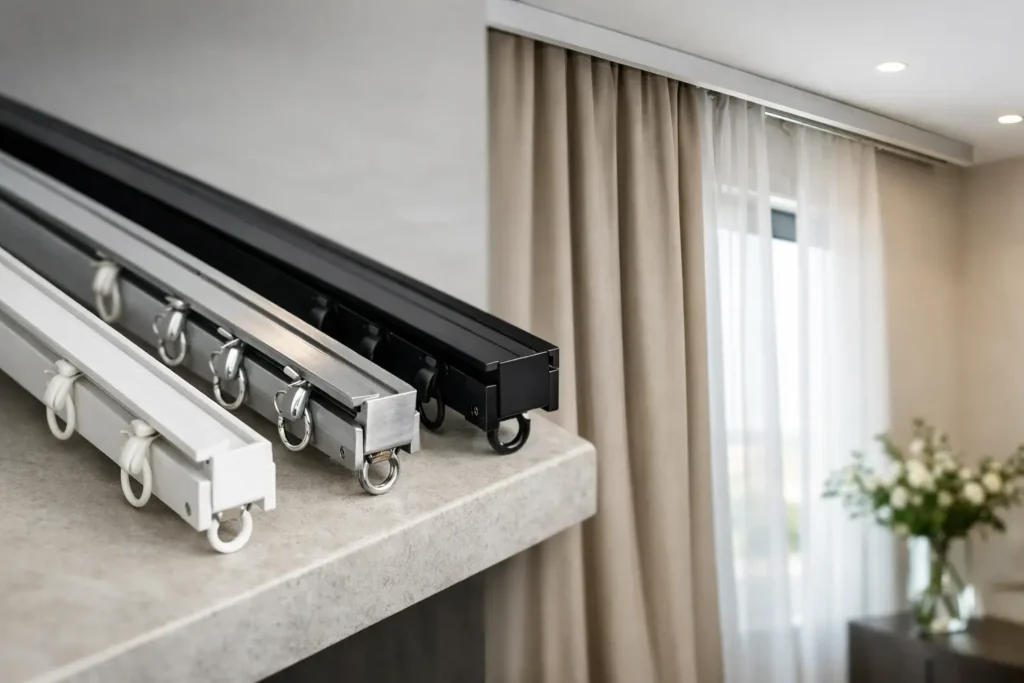
A beautiful curtain fabric can lose its impact when the track is too visible, too weak, or positioned awkwardly above the window. Thoughtful curtain track selection is what gives custom drapery its smooth movement, precise proportions, and high-end finish. It determines how the curtains open, where they stack, how much light enters, and whether the final result feels carefully designed or simply fitted.
For a bedroom blackout treatment, a formal living room with layered sheers, or a motorized curtain wall in an office, the right track should support both the look and the daily use of the room. The best choice is rarely based on one detail alone. Fabric weight, window shape, ceiling height, room function, and the desired level of automation all matter.
Start With How the Curtains Need to Work
Before choosing a track profile or finish, consider what the curtains need to do each day. A decorative treatment that remains mostly open has different requirements from blackout curtains that will be drawn every morning and evening. In bedrooms, smooth closure and close edge coverage are usually priorities. In living areas, the focus may be on graceful folds, generous stacking, and the ability to layer sheer and blackout fabrics.
Think about the direction of operation as well. Center-opening curtains create a balanced, classic look on wide windows and patio doors. One-way opening curtains can be more practical when furniture, a balcony door, or a wall sits close to one side of the window. For extra-wide glazing, a center-opening system often reduces the distance each panel needs to travel and makes the curtains easier to manage.
A track should also be selected around the frequency of use. A lightweight manual track may suit a guest room, while a frequently used master bedroom, hotel suite, or conference room benefits from a stronger gliding system or motorized operation. The goal is not to over-specify every room. It is to choose a solution that stays reliable and refined over time.
Curtain Track Selection Begins With Fabric Weight
Curtains are not all the same weight, and the track should never be treated as an afterthought. Airy sheers generally move easily on slim profiles, while lined blackout curtains, interlined drapes, velvet, and soundproof curtains place far more load on brackets, runners, and fixings.
A premium track must carry the full weight without sagging in the middle or pulling away from the mounting surface. This becomes especially important on wide windows, floor-to-ceiling curtain designs, and double-height spaces. If a heavy fabric is installed on a track with insufficient support, the result may be uneven movement, noisy gliding, and a finish that quickly loses its clean appearance.
The fullness of the curtain matters too. Luxurious drapery often uses more fabric to create deeper, more elegant folds. That added fullness improves the visual effect but increases the weight and the amount of space needed when the curtains are open. A professional measurement ensures the track, brackets, and stacking allowance are planned as one complete system.
Single, Double, and Triple Tracks
A single track is ideal when one curtain layer provides all the privacy and light control required. It works well for blackout curtains in a bedroom, simple sheers in a low-privacy area, or a clean, minimal office treatment.
Double tracks are a popular choice for homes that want sheer curtains during the day and blackout or dimout curtains at night. The sheer layer softens daylight and adds privacy without closing the room off, while the main curtain provides stronger light control and a more dramatic evening look. This layered approach is especially effective in living rooms, master bedrooms, and hotel-style interiors.
Triple tracks can be useful for more specialized designs, such as a sheer, blackout curtain, and decorative side panels. They require careful planning because every additional layer needs depth, smooth access, and enough space to stack properly. When the window recess is limited, a ceiling-mounted recessed track may provide a cleaner solution than fitting several visible rods or bulky hardware.
Choose a Mounting Style That Supports the Design
The position of the track changes the apparent size and finish of the room. Ceiling-mounted tracks are often the preferred option for contemporary interiors because they create a continuous line from ceiling to floor. They make windows appear taller, conceal the hardware, and allow curtains to frame large glass doors with a tailored, architectural look.
Wall-mounted tracks are practical where ceiling mounting is not possible or where a decorative pelmet, cornice, or existing ceiling detail influences the installation. They can still look elegant, but the height and projection must be considered carefully. Mounting the track too close to the window can cause curtains to catch on handles, blinds, or deep window sills.
Recessed tracks offer one of the most polished finishes. Installed inside a ceiling pocket, they allow curtains to appear as though they are emerging directly from the ceiling. This is a strong choice for modern villas, luxury apartments, hospitality projects, and spaces with motorized curtains. However, recessed tracks are easiest to plan during renovation or new construction, before ceiling work is complete.
Consider the Window Shape, Not Just Its Width
Standard straight windows are straightforward, but many spaces need a more considered approach. Bay windows, curved walls, corner glazing, and wraparound balcony doors can all require specially shaped or flexible tracks. Forcing a straight track across a curved or angled opening often creates gaps, awkward fabric stacking, and an unfinished appearance.
Corner windows need particular attention. The curtains should travel around the corner smoothly if full coverage is required, especially for privacy or blackout performance. Depending on the design, a continuous bent track may be preferable to two separate tracks that leave an uncovered break at the corner.
Measure beyond the glass itself. The track should typically extend past each side of the window so that open curtains can stack clear of the view and allow more natural light into the room. The exact extension depends on fabric fullness, curtain style, and wall space. This is one reason expert measuring delivers a noticeably better result than relying on window dimensions alone.
Manual or Motorized: Match Convenience to the Space
Manual tracks remain an excellent choice for many rooms. Modern quality tracks glide quietly and easily when installed with the correct runners and supports. They are practical, cost-effective, and well suited to windows that are easy to reach.
Motorized curtain tracks add convenience where curtains are wide, heavy, high, or used frequently. With the touch of a remote, wall switch, or smart-home command, curtains can open at sunrise, close for privacy, or adjust during the hottest part of the day. In rooms with tall ceilings or hard-to-reach windows, automation is often less of a luxury and more of a practical improvement.
Motorization also creates a more consistent experience for delicate or heavy fabrics. Rather than pulling one side unevenly by hand, the system moves at a controlled pace. Still, automation needs early planning. Power access, track placement, fabric weight, and the chosen control method should all be confirmed before installation. Battery-powered options can work in some settings, while wired systems are often preferred for large-scale or long-term installations.
Do Not Overlook Stack-Back and Light Gaps
One of the most common frustrations with curtains is discovering that they cover too much of the window when open or allow unwanted daylight around the edges when closed. Both issues are usually track-planning issues, not fabric issues.
Stack-back is the amount of space the curtain occupies when gathered open. Heavier fabrics and fuller headings require more of it. If the wall area beside the window is narrow, the fabric may partly cover the glass even when fully opened. A track that extends farther, a different heading style, or a center-opening layout may improve the result.
For blackout bedrooms, side light gaps deserve equal attention. Extending the track beyond the window frame, mounting it close to the ceiling, and selecting the right return can reduce light leakage significantly. Complete darkness depends on the window shape and installation conditions, so it is best to discuss expectations during the measurement stage rather than after fitting.
A Professional Finish Comes From the Full System
The track, fabric, heading, brackets, runners, and installation surface must work together. Even the most beautiful curtain can look ordinary when the hardware is undersized or poorly aligned. Conversely, a well-planned track lets the fabric hang in clean, even waves and makes opening and closing feel effortless.
At Elegant Blinds & Curtains, custom measurements help match each track system to the room, fabric, and lifestyle of the client. From discreet ceiling tracks and layered curtain systems to automated solutions for large windows, the focus is on a finish that looks elegant and performs beautifully.
If you are planning new curtains, arrange a professional measurement before choosing the final fabric. Seeing the window, wall space, ceiling condition, and daily use of the room in person is the simplest way to select a track that will look right from the first fitting and continue to serve the space beautifully.